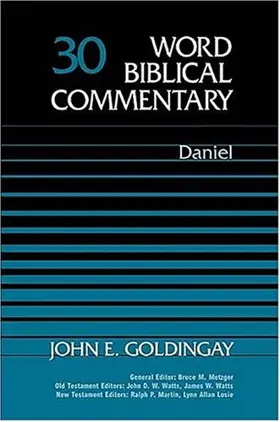
Daniel
Pages
406
Publisher
Thomas Nelson
Published
1/1/1989
ISBN-13
9780849902291
Collections
This book appears in the following featured collections.
- Recommended OT Commentaries by Denver Seminary Journal
- Ultimate Commentary Collection: OT Technical by John Glynn
- Favorite Advanced OT Commentaries by Jeremy Pierce (parableman)
- Best Advanced OT Commentaries by Jason Gile
- Commentaries I Would Not Do Without by R. Hansen
- Essential OT Commentaries for a Preacher's Library by Derek W. H. Thomas
- Old Testament Advanced Commentaries by Moore Theological College Journal: Societas
- Building an OT Commentary Library by Invitation to Biblical Interpretation (Kostenberger & Patterson)
- TGC: Scholarly Commentaries by The Gospel Coalition
Reviews
The Gospel Coalition
 June 1, 2024
June 1, 2024
Goldingay uncovers the mysteries of Daniel, illuminating Daniel’s historical setting and using it to explain the book’s prophecies. His comprehensive work analyzes the composition of the book, demonstrating an amazing grasp of the secondary literature. He also provides a fresh translation. Though readers “will be put off by some of his radical (at least for an evangelical) conclusions, most notable of which are that the stories in chapters 1– 6 are fictitious and the visions are quasi-prophecies,” Longman contends “it would be a major mistake to ignore this important commentary.”
[Full Review]
G Ware
 December 10, 2015
December 10, 2015
Goldingay is an erudite, and accomplished scholar and commentary writer (his 3 vols on Psalms is the only commentary on Psalms you will ever need). This volume on Daniel is worthy of pride of place on Pastors' and scholars' shelves. I usually don't like to get into speculation regarding dates of biblical texts, since it's just that- speculation. But in the case of Daniel, it does have a significant impact. I am inclined to agree with Goldingay that Daniel is a composition of the 2nd century BC, which sets events in the 6th. Chapter 8 epsecially makes far more sense when read from this vantage point. The late date assertion will (and has) turn(ed) many readers off. Nevertheless, my own humble opinion is that Goldingay is correct on that way, and his unpacking of the text in light of that makes a murky and difficult text far more comprehensible.
nathan_soper
March 24, 2015
March 24, 2015
Very thoughtful and useful exegesis, sadly holds to a late date and speaks of "quasi-prophecy" but still much that is helpful.
Tim Challies
 April 14, 2014
April 14, 2014
Sinclair Ferguson’s volume is considering top-notch by many of the experts. Keith Mathison praises it by saying, “Students of Scripture should read anything that Sinclair Ferguson publishes, and his commentary on Daniel is no exception. Although aimed specifically at pastors, this commentary is accessible to a general readership as well. Very helpful.”
[Full Review]
Marcus Maher
 November 15, 2010
November 15, 2010
It was a very close call but my favorite commentary on Daniel is Goldingay's. While there were a few places where I disagreed with his interpretation, I found the commentary to be exemplary. If you're going to teach Daniel, especially the apocalyptic portions, you need a commentary that provides you with a lot of background material. Goldingay, while not as broad as Collins, certainly provides you with quite a bit. His exploration of the background to the apocalyptic symbolism is very helpful. You gain a good sense of what is being communicated by the symbols, not just to whom they refer. Questions of genre are discussed in detail; helpful parallel texts are dug up (while avoiding parallelomania). The most helpful aspect of the commentary was his detailed literary analysis. It showed how the passage as a whole fit together, especially pointing out chiasms in the text. His explanations should not be ignored either. These are among the best of any in the Word series and clearly are far from the afterthought that they seem to be in some volumes. Overall, I found this commentary to be detailed but you never feel overloaded at the same time.
Daniel is a bit of a battle ground in Evangelical circles over dating. For those of you interested, Goldingay does hold to a second century date and sees many of the prophetic portions as ex eventu prophecy. This raises theological issues for the doctrine of Scripture for Evangelicals (of which Goldingay is one). I give him credit for dealing with them head on. I personally learned a lot from Goldingay, and even if you disagree with this stance on the dating of Daniel, I think you will too. No pastor should attempt to study Daniel without this commentary in his collection.
[Full Review]

Jonathan C.
September 24, 2008
September 24, 2008
Although other reviewers have already noted it, Goldingay's view on what is commonly believed to be prophecy is saddening. The fact that he denies the validity of the book as a whole makes this volume well worth passing on. To it's credit, it will usually deal with the different elements of the text. However, the conclusions, like noted by other reviewers, are quite liberal and hardly worth attributing merit to.
Additionally, the format of the commentary is very confusing.

Derek W. H. Thomas
 September 19, 2008
September 19, 2008
Despite a 2nd century date and viewing the visions as pseudonymous 'quasi-prophecy,' deals ably with the text.
Denver Seminary Journal
 June 16, 2008
June 16, 2008
Detailed comments with comparisons with biblical and non-biblical parallels. Defends a late date. Evangelical.
[Full Review]