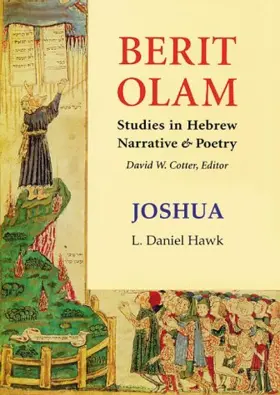
Joshua
in Berit Olam: Studies in Hebrew Narrative and Poetry
Pages
344 pages
Publisher
Liturgical Press
Published
1/1/2001
ISBN-13
9780814650424
What does Joshua hold to be the essential marks of Israelite identity? What distinguishes "Israel" from all other peoples? In tracking these themes, L. Daniel Hawk reveals in Joshua a profound struggle to define the people of the God of Israel.
Hawk shows that the themes surrounding Joshua express fundamental markers of national identity: religious practice (obedience to the commandments of Moses), ethnic separation (extermination of the peoples of Canaan), and possession of land ("the land that YHWH gives"). Through the medium of narrative, Joshua tests each of these markers and demonstrates that none clearly characterize the people of God. Instead, Joshua presents Israel as a nation fundamentally constituted by choosing: YHWH's choosing of Israel and Israel's choosing of YHWH.
In the present day in which ideologies of religion, race, and territorial possession have given rise to countless expressions of violence, Hawk expresses the particular value of reading Joshua. The Joshua story holds a mirror up to all who regard themselves as the people of God. The reflection is both repelling and inspiring but until we confront it, what it truly means to be the chosen people of God will remain elusive.
Chapters are "Rights of Passage (1:1-18)," "Who's Who in the Promised Land? (2:1-12:24)," "Strangers in the Night (2:1-24)," "Changing State (3:1-4:24)," "First Things First (5:1-15)," "Going in Circles (6:1-27)," "Ai Spy (7:1-8:35)," "Foiled Again (9:1-10:27)," "Conquering Canaanites (10:28-12:24)," "Organizing Israel (13:1-21:45)," "Altar Egos (22:1-34)," "Unfinished Business (23:1-18)," and "Decisions, Decisions (24:1-33)." Includes twelve charts that lay out structural features of the book.
Hawk shows that the themes surrounding Joshua express fundamental markers of national identity: religious practice (obedience to the commandments of Moses), ethnic separation (extermination of the peoples of Canaan), and possession of land ("the land that YHWH gives"). Through the medium of narrative, Joshua tests each of these markers and demonstrates that none clearly characterize the people of God. Instead, Joshua presents Israel as a nation fundamentally constituted by choosing: YHWH's choosing of Israel and Israel's choosing of YHWH.
In the present day in which ideologies of religion, race, and territorial possession have given rise to countless expressions of violence, Hawk expresses the particular value of reading Joshua. The Joshua story holds a mirror up to all who regard themselves as the people of God. The reflection is both repelling and inspiring but until we confront it, what it truly means to be the chosen people of God will remain elusive.
Chapters are "Rights of Passage (1:1-18)," "Who's Who in the Promised Land? (2:1-12:24)," "Strangers in the Night (2:1-24)," "Changing State (3:1-4:24)," "First Things First (5:1-15)," "Going in Circles (6:1-27)," "Ai Spy (7:1-8:35)," "Foiled Again (9:1-10:27)," "Conquering Canaanites (10:28-12:24)," "Organizing Israel (13:1-21:45)," "Altar Egos (22:1-34)," "Unfinished Business (23:1-18)," and "Decisions, Decisions (24:1-33)." Includes twelve charts that lay out structural features of the book.
Collections
This book appears in the following featured collections.
- Favorite Advanced OT Commentaries by Jeremy Pierce (parableman)
- Top Old Testament Commentaries by Engaging Scripture (Nijay Gupta's Substack)
Reviews

Hawk’s attention to the text’s narrative art is superb. By tracing a theme of “boundaries” (ethnic, land) throughout the text, his commentary also clearly addresses contemporary questions.
[Full Review]
Aaron
 September 8, 2020
September 8, 2020
This is a well constructed commentary that addresses the big questions of the book. It treats textual issues only when they are critical, instead favoring narrative as the title would suggest.
Princeton Theological Seminary
 January 5, 2018
January 5, 2018
Offers a more literary approach to Joshua.
Review of Biblical Literature (RBL) (Richard D. Nelson)
 November 1, 2002
November 1, 2002
Collegeville, MN: The Liturgical Press, 2000. Pp. xxxii + 303, Hardcover, $39.95, ISBN 0814650422. Richard D. Nelson Perkins School of Theology Dallas, TX 75275 The Berit Olam series offers commentaries that provide literary and theological readings of the books of the Hebrew Bible in their final forms. This contribution by L. Daniel Hawk interprets the Masoretic Text of Joshua as a structured and coherent whole, offering a balanced and generally persuasive example of close reading. Common sense takes precedence over methodological extremism, so that the reader has no trouble following Hawk’s argument and agreeing that it is consistent and sound. Joshua proves to be about Israel’s ethnicity and the boundaries and markers that constitute that identity. Who is inside and who is outside the boundary of peoplehood? However, there are discontinuities between what text asserts about identity on the surface level and contradictory and dissolving elements that undercut the seemingly apparent answer to the identity question. This literary shape promotes a less obvious, but more profound image of Israel’s identity. The narratives of Joshua might seem to promote an identity based on ethnic separation leading to the destruction of the alien outsider, uncontested possession of a God-given land, and proper worship in obedience to the commandments of Moses. However, the book of Joshua also invites the reader to test each of these identity markers and demonstrates that none clearly characterize the people of God. Read holistically and carefully, the text does not let these indications of ethnicity stand unequivocally, but undermines them with other elements and contrary viewpoints. In end a different sort of marker of identity emerges, focused especially in Joshua 24. Israel’s true identity is as a people chosen by God, who have decided and are to decide to choose for the God who has chosen them. Hawk’s reading discovers chiastic structures, lexical patterns, and common plots (notably between the stories of Rahab and Sodom and the destruction of Sodom and of Jericho). Helpful charts illustrate such patterns and parallels.
[Full Review]