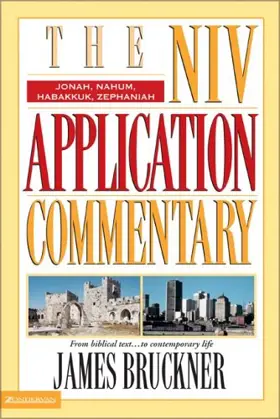
Jonah, Nahum, Habakkuk, Zephaniah
Pages
368
Publisher
Zondervan
Published
1/1/2004
ISBN-13
9780310206378
Collections
This book appears in the following featured collections.
- Favorite Commentaries for Personal Study by Jeremy Pierce (parableman)
- Ultimate Commentary Collection: OT Expositional by John Glynn
- Top Old Testament Commentaries by Engaging Scripture (Nijay Gupta's Substack)
Reviews
Bryan Vincent
 January 18, 2025
January 18, 2025
I’m a pastor in a non-denominational church and recently preached through Jonah. I had the opportunity to use a number of commentaries, which are listed below. I wanted to take a moment and share my experience with these resources because bestcommentaries.com has been so incredibly helpful for me. I hope my insights can guide you as well! Here are the commentaries, ranked in order of preference (which ones I would recommend purchasing first) and organized into three tiers. I also hope others will follow my example and share their experiences, too.
- - -
Must-Buys
JoAnna Hoyt (EEC)
James Bruckner (NIVAC)
Joyce Baldwin (McComiskey Set)
James D. Nogalski (NICOT)
Bryan Estelle (GAOT)
- - -
Almost Must Buys
Leslie Allen (NICOT)
Daniel Timmer (NSBT)
O. Palmer Robertson
O. Palmer Robertson
Douglas Stuart (WBC)
- - -
Potential Must-Buys
Gordon Keddie (WCS)
Kevin Youngblood (ZECOT)
Alexander, Baker, Waltke (TOTC)
Sinclair Ferguson
- - -
PastorTimothy72
July 27, 2021
July 27, 2021
I have become a collector of commentaries ever since my seminary days in the 1990s. As such, I am only going to recommend the best overall commentary for each book of the Bible on this site. (Before each minor prophet recommendation, let me first say that every preacher/teacher should have a copy of James Montgomery Boice's two volume set on the Minor Prophets on his/her bookshelf. That's the starting point, in my opinion). I am giving Bruckner the nod on Habakkuk on this site primarily because I did not see John Currid's work with Welwyn's Commentaries listed. I find Currid to be a straight forward and helpful even if a bit too brief at times. In the spirit of Currid, Bruckner is also accessible and practical. (I recommended Richard Patterson from Wycliffe series for Nahum: he is good re: Habakkuk and Zephaniah, too).
Jeremy Pierce (parableman)
August 7, 2009
August 7, 2009
James Bruckner's commentary is a decent example of what the NIVAC series seeks to do. It gives a very brief exegesis, briefer even than Baker's. Part two of his treatment of each passage is his reflection on the general principles from the original context that might transfer to ours. Part three for each unit moves on to suggestions for how those principles might apply in our context. I only looked at the Zephaniah part of this commentary, but someone I know who read the whole book was considerably disappointed with his Original Meaning sections. I liked some of what I read in the Bridging Contexts sections. He doesn't simply moralize but rather spends time thinking through what principles in the text can be generalized to move toward other contexts. I didn't come away with a strong positive or negative impression of his Contemporary Application discussions. I know readers outside the U.S. complain that this series tends to focus on American examples, but the main point of the series is to model how to apply the second Bridging Contexts section in a concrete setting. Surely the author doesn't think those ways are the only ways they will apply or even the most important for every setting. If you approach this series in that way, I think it's often excellent.
[Full Review]
Jeremy Pierce (parableman)
August 7, 2009
August 7, 2009
James Bruckner's commentary (2004) is a decent example of what the NIVAC series seeks to do. It gives a very brief exegesis, briefer even than Baker's. Part two of his treatment of each passage is his reflection on the general principles from the original context that might transfer to ours. Part three for each unit moves on to suggestions for how those principles might apply in our context. I only looked at the Zephaniah part of this commentary, but someone I know who read the whole book was considerably disappointed with his Original Meaning sections. I liked some of what I read in the Bridging Contexts sections. He doesn't simply moralize but rather spends time thinking through what principles in the text can be generalized to move toward other contexts. I didn't come away with a strong positive or negative impression of his Contemporary Application discussions. I know readers outside the U.S. complain that this series tends to focus on American examples, but the main point of the series is to model how to apply the second Bridging Contexts section in a concrete setting. Surely the author doesn't think those ways are the only ways they will apply or even the most important for every setting. If you approach this series in that way, I think it's often excellent.
[Full Review]


Denver Seminary Journal
 June 16, 2008
June 16, 2008
Helpful exposition with solid application for today. Evangelical.
[Full Review]
Denver Seminary Journal
June 16, 2008
June 16, 2008
Helpful exposition with solid application for today. Evangelical.
[Full Review]
Denver Seminary Journal
June 16, 2008
June 16, 2008
Helpful exposition with solid application for today. Evangelical.
[Full Review]
Denver Seminary Journal
June 16, 2008
June 16, 2008
Helpful exposition with solid application for today. Evangelical.
[Full Review]