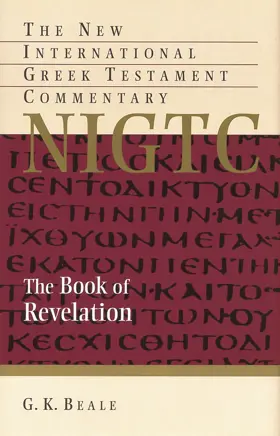
The Book of Revelation
in New International Greek Testament Commentary
This monumental new study of the book of Revelation will be especially helpful to scholars, pastors, students, and others seriously interested in interpreting the Apocalypse for the benefit of the church. Too often Revelation is viewed as a book only about the future. As G. K. Beale shows, however, Revelation is not merely a futurology but a book about how the church should live for the glory of God throughout the ages—including our own.
Engaging important questions concerning the interpretation of Revelation in scholarship today, as well interacting with the various viewpoints scholars hold on these issues, Beale's work makes a major contribution in the much-debated area of how the Old Testament is used in the Apocalypse. Approaching Revelation in terms of its own historical background and literary character, Beale argues convincingly that John's use of Old Testament allusions—and the way the Jewish exegetical tradition interpreted these same allusions—provides the key for unlocking the meaning of Revelation's many obscure metaphors. In the course of Beale's careful verse-by-verse exegesis, which also untangles the logical flow of John's thought as it develops from chapter to chapter, it becomes clear that Revelation's challenging pictures are best understood net by apparent technological and contemporary parallels in the twentieth century but by Old Testament and Jewish parallels from the distant past.
Collections
This book appears in the following featured collections.
- John Piper's NT Commentary Recommendations by John Piper (Desiring God)
- Favorite Advanced NT Commentaries by Jeremy Pierce (parableman)
- D. A. Carson's Commentary "Best Buys" by D. A. Carson
- Essential NT Commentaries for a Preacher's Library by Derek W. H. Thomas
- New Testament Advanced Commentaries by Moore Theological College Journal: Societas
- Cambridge Chinese Christian: Recommended Commentaries by Calvin Cheah
- Building an NT Commentary Library by Invitation to Biblical Interpretation (Kostenberger & Patterson)
- The Pastor’s Bookshelf by Scot McKnight
- Nijay Gupta's Top NT Commentaries by Nijay K. Gupta
- Recommended New Testament Commentaries for Evangelical Pastors by Thomas R. Schreiner
- TGC: Scholarly Commentaries by The Gospel Coalition
Reviews
 December 20, 2024
 June 1, 2024
 May 19, 2023
 December 10, 2016
October 11, 2016
December 10, 2016
October 11, 2016
 February 3, 2014
December 20, 2012
February 3, 2014
December 20, 2012
 August 13, 2012
June 2, 2012
August 13, 2012
June 2, 2012
 December 18, 2009
 June 20, 2009


 May 22, 2000