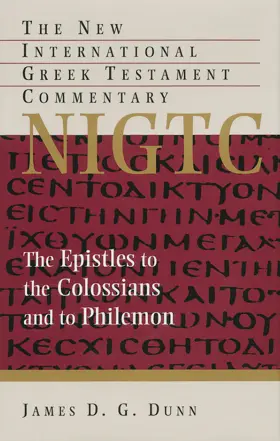
The Epistles to the Colossians and to Philemon
in New International Greek Testament Commentary
In this volume in the celebrated New International Greek Testament Commentary series, James D. G. Dunn, author of numerous well-received works on the historical origin and theological interpretation of the New Testament, provides detailed expositions of the text of Paul’s letters to the Colossians and to Philemon.
Dunn examines each of these letters within the context of the Jewish and Hellenistic cultures in the first century, and he discusses the place of Colossians and Philemon in the relationship between the Pauline mission and the early churches that received these letters. He places particular stress on the role of faith in Jesus Christ within and over against Judaism and on the counsel of these two important letters with regard to the shaping of human relationships in the community of faith.
Collections
This book appears in the following featured collections.
- Favorite Advanced NT Commentaries by Jeremy Pierce (parableman)
- D. A. Carson's Commentary "Best Buys" by D. A. Carson
- New Testament Advanced Commentaries by Moore Theological College Journal: Societas
- Basic Library Booklist by Detroit Baptist Theological Seminary
- Building an NT Commentary Library by Invitation to Biblical Interpretation (Kostenberger & Patterson)
- The Pastor’s Bookshelf by Scot McKnight
- New Testament Commentaries & Monographs by Princeton Theological Seminary
- Nijay Gupta's Top NT Commentaries by Nijay K. Gupta
- Recommended New Testament Commentaries for Evangelical Pastors by Thomas R. Schreiner
Reviews
 September 13, 2019
 April 24, 2018

 June 26, 2012
 August 2, 2009
 February 21, 2009


 July 31, 2000