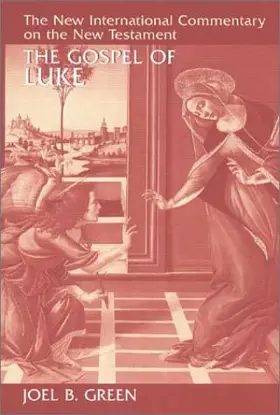
The Gospel of Luke
in New International Commentary on the New Testament
Pages
928
Publisher
Eerdmans
Published
1/1/1997
ISBN-13
9780802823151
Collections
This book appears in the following featured collections.
- Recommended NT Commentaries by Denver Seminary Journal
- New Testament Advanced Commentaries by Moore Theological College Journal: Societas
- Building an NT Commentary Library by Invitation to Biblical Interpretation (Kostenberger & Patterson)
- The Pastor’s Bookshelf by Scot McKnight
- New Testament Commentaries & Monographs by Princeton Theological Seminary
- Nijay Gupta's Top NT Commentaries by Nijay K. Gupta
- Recommended New Testament Commentaries for Evangelical Pastors by Thomas R. Schreiner
- TGC: Scholarly Commentaries by The Gospel Coalition
Reviews
The Gospel Coalition
 June 1, 2024
June 1, 2024
Green’s commentary of nearly a thousand pages helps readers see broader literary connections, themes, and cultural background material. The commentary is thought-provoking and filled with thoughtful interaction with contemporary scholarship. Carson says its “forte” is “narrative historiography and discourse analysis,” but notes one downside of Green’s almost exclusively literary reading; this means Green downplays discussion about the relation between Luke and the other Synoptics, including the major historical issues implicit in such discussions.
[Full Review]
DrRobert
 December 1, 2021
December 1, 2021
This is a literary analysis, not a commentary. A lot of space is wasted on the analysis of textual structures. Studying Lukan narrative we are kept at arm's length from the real people and circumstances that Luke describes. What were the hopes, fears, burdens and expectations of the men and women who encountered Jesus? How did they each respond to him? What were their personal circumstances - their spiritual, cultural, social, psychological and historical context? We have no help with this. In the cleansing of the leper, for example, we learn nothing about leprosy. In the healing of the paralysed man who came through the roof we are not shown how anyone felt about anything. The analysis of co-text, inter-text, narrative structures etc. leaves the reader with very little fresh insight or encouragement. A few years ago it was fashionable to focus on the people reading the text, now on the person writing the text. Perhaps soon we will rediscover the people actually in the text and study their situation and experience and see what it meant for them.
ZachWLambert
September 14, 2020
September 14, 2020
I've used this site dozens of times over the years, but I signed up just now so that I could review this commentary by Joel Green. It's "Top 2" and it ain't #2. By far the best I've ever walked through.
Warren Truesdale
March 31, 2019
March 31, 2019
This is a unique and fascinating commentary on Luke. Green focuses primarily on the literary features of the narrative—discourse analysis. He also draws out sociological backgrounds and implications of the narrative. Green argues, “As historiographical narrative, the Gospel of Luke consists of a series of event-accounts. The significance of each of these accounts is incomplete when viewed on its own.
[Full Review]

Phillip J. Long
 July 29, 2017
July 29, 2017
Green’s commentary on Luke in the NICNT series represents something of a renaissance for that series. The earlier contributions were good, but not as highly detailed this excellent commentary. Green’s commentary replaces Geldenhuys’ in the series. The commentary is primarily based on English, lexical and syntactical details are found in the footnotes. This makes for a very readable commentary and one that will be the “first off the shelf” for me for years to come. One aspect of this commentary which I appreciate are the short excursus-style sections which focus on Greco-Roman backgrounds. These are in a smaller font which might imply they can be skipped – but these sections are excellent! Green is now the general editor of the NICNT series, following Ned Stonehouse, F. F. Bruce, and Gordon Fee.
Joel B. Green
 May 13, 2015
May 13, 2015
The commentary on Luke in the NICNT (Eerdmans, 1997), by Joel B. Green, brings together socio-cultural and narrative concerns so as to allow an extended engagement with Luke’s literary art and his theology, ethics, and spirituality.
[Full Review]
G Ware
March 5, 2015
March 5, 2015
This is where I go first. Condensing Luke into a single volume while still being comprehensive is an unenviable task. Green has capably achieved just that. I finely written, but never lacking in detail commentary, which balances scholarly rigour with pastoral relevance. If you can only choose one commentary on Luke, this really should be it.
Tim Challies
 March 11, 2013
March 11, 2013
Most commentators on the commentaries commend this volume, D.A. Carson among them, though he offers caveats. He says it is “full of thoughtful interaction with contemporary scholarship, but I do not think it is either as rigorous or as accurate as the work of Luke.” He suggests that its unique strength is narrative historiography and discourse analysis. If you, like me, don’t know what that means, then perhaps choose one of the other volumes!
[Full Review]
John Philip
 May 6, 2010
May 6, 2010
My hero! This was brilliant. Besides the difficulty in getting used to his technical style of writing, I learnt so much from it and how to study scripture.
Scot McKnight
 April 21, 2009
April 21, 2009
It combines wide-ranging reading, a narrative approach, and readable prose.
[Full Review]


Review of Biblical Literature (RBL) (Robert C. Tannehill)
 February 15, 1999
February 15, 1999
Grand Rapids: Eerdmans, 1997. Pp. xcii + 928, Cloth, No Price Available, ISBN 0802823157. Robert C. Tannehill Methodist Theological School in Ohio Delaware, OH 43015 Joel Green's commentary focuses on the Gospel of Luke in its final form, viewed as a literary work. It is a strict and complete example of a recent trend to abandon the methods of tradition history, form criticism, and redaction criticism. Green does not even make comparisons of Lukan material with other Gospels. He does not assume, however, that a literary work can be understood apart from a cultural context. "All language is embedded in culture," Green writes. Hence we must be concerned with Luke's "social setting," and by this we mean more than "narrative world" as this phrase is used in narrative criticism. We mean more than the world available to us only through the narrative viewed as a closed system, but less than the world often represented to us by historical-critical inquiry. The former strips the Gospel of Luke of its cultural embeddedness, while the latter assumes too easily that the (real) social world wherein Luke's story is set can and should simply be read into Luke's narrative. As we will see, Luke does not represent the "real world" so straightforwardly, but both seeks to provide an alternative view of that world and chooses aspects of that world to emphasize while downplaying others (p. 12). Green's point is important. No literary work can be divorced from its cultural context, yet that context can be interpreted in various ways. A significant literary work is engaged in presenting its own interpretation of social life.
[Full Review]